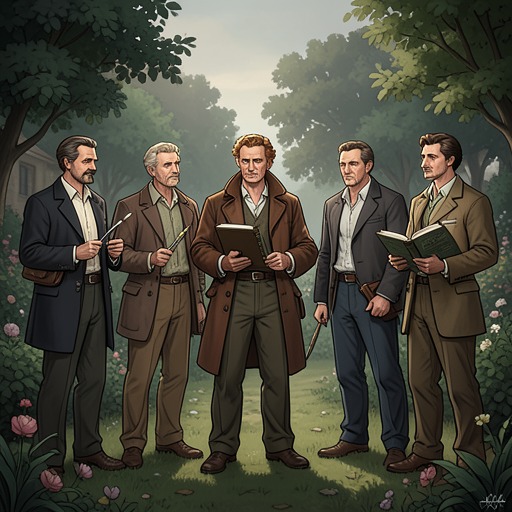
Cronshaw’s funeral
Of Human BondageCronshaw’s funeral brings together Philip’s practical care for his dead friend and Leonard Upjohn’s talent for turning that care into literary material. Philip arranges a moderate funeral because he must meet its cost; Upjohn later recasts the unadorned burial as the final triumph of Philistinism over art, while his account also advances his own reputation as a critic.
Arrangements and Burial
With the expense falling to him and his finances strained, Philip has tried to keep the funeral moderate. Upjohn mocks the choice, suggesting a pauper’s funeral would have been more poetic and accusing Philip of an instinct for mediocrity. Philip flushes but does not answer. The next day, he and Upjohn follow the hearse in the single carriage Philip ordered. Lawson cannot attend, but sends a wreath; Philip buys two more so the coffin will not appear neglected.
On the return journey, the coachman drives the horses faster. Exhausted, Philip falls asleep in the carriage and wakes to hear Upjohn considering how to publish his writing about Cronshaw. The shift from burial to literary plans is immediate: Philip has supplied the funeral’s modest gestures of care, while Upjohn is already shaping the death into a public narrative.
Upjohn’s Account of Cronshaw
A few weeks later, Upjohn’s article appears in the monthlies, attracts notice, and is excerpted in newspapers. Since little is known of Cronshaw’s early life, the piece is only vaguely biographical. Upjohn instead makes him a picturesque English poet in the manner of Verlaine, placing him in the Latin Quarter as a talker and writer before describing his shabby last days in Soho.
The article presents Philip’s care through Upjohn’s own language and framing. It describes an effort to move the dying poet to a cottage amid an orchard, then treats the decision to take him to Kennington as a lapse into vulgar respectability. Upjohn depicts Cronshaw’s patience with the young student who had made himself his nurse, and sets the poet’s final surroundings against his image as a vagabond. These details are not simply a record of the funeral: they turn Philip’s attempts to help into evidence for Upjohn’s contrast between art and the middle-class world.
The Funeral as Literary Irony
Upjohn’s account gives the burial a symbolic shape. He describes a friend laying a laurel wreath on Cronshaw’s heart, then ends with the ordinary, middle-class funeral of a poet who, in the article’s telling, should have been buried either like a prince or like a pauper. The contrast makes the modest ceremony into an ironic conclusion: neither grand recognition nor deliberately poetic destitution, but a practical funeral arranged by a friend who is short of money.
The article is effective partly because it transforms the very details Upjohn disparaged. Philip’s extra wreaths, bought so the coffin would not seem neglected, become a laurel wreath resting on the dead poet’s hands in Upjohn’s stylized prose. A private act of consideration is thus recast as an emblem of artistic dignity, even as the funeral’s actual modesty is used to dramatize art’s defeat by respectability.
Aftermath and Significance
The article is described as Upjohn’s best writing: delicate, tender, picturesque, and marked by charm, grace, and pity. Its circulation raises his standing; he is thereafter regarded as a critic to be reckoned with, and the piece also reveals a warmth that had seemed absent from his earlier manner. Yet Upjohn prints Cronshaw’s best poems within the article, diminishing the impact of the volume when it later appears. The funeral therefore becomes an occasion both for memorializing Cronshaw and for Upjohn’s professional advancement.
The event holds a tension between material obligation and artistic interpretation. Philip’s decision is governed by what he can afford and by a wish that the coffin not look neglected; Upjohn turns that constrained, ordinary care into a polished story about art, poverty, and respectability. The gap between the burial as Philip arranges it and the burial as Upjohn publishes it is the funeral’s lasting narrative consequence.